
Financial Control
For any business that wants to succeed, ongoing financial control is crucial.

What Is Financial Control
Financial control is the coordination of activities and the assessment of a business's financial condition, drawn from financial reports built from asset data and cash flow status.
Through it, the business owner learns how, where, when, and how much money was earned and spent, making it possible to forecast expenses and revenue and understand inflows, outflows, income, and dividends.
Useful for business decision-making, these controls should be done frequently and are essential to day-to-day operations — they are also the first step toward working-capital management. Good working-capital management for small businesses, for example, resolves most financial-nature problems on its own.
Basic Types of Financial Control
Daily cash control
Records every cash inflow and outflow and calculates the current cash balance.
Bank control
Daily record of bank transactions and control of existing balances.
Daily sales control
Tracking of daily sales and accumulated sales totals over the month.
Accounts-receivable control
Control of amounts to be received (installment sales).
Accounts-payable control
Control of the bills the company must settle.
Monthly expense control
Recording each expense amount, tracking its trend over time.
Inventory control
The record provides information for restocking sold products and reducing idle inventory.
Cash flow control
Projecting future inflows and outflows to anticipate cash shortfalls or surpluses.
How to Do Financial Control?
Nowadays, the best way to run financial control is through financial-management software. This way, when mistakes happen, they're easier to spot. Such software is also easier to use, more practical, and better organized than the older options used in the past.
Why Use Financial Control Software?
Built to manage a company's entire financial department, Financial Control Software saves time, costs little, and optimizes your business's financial control.
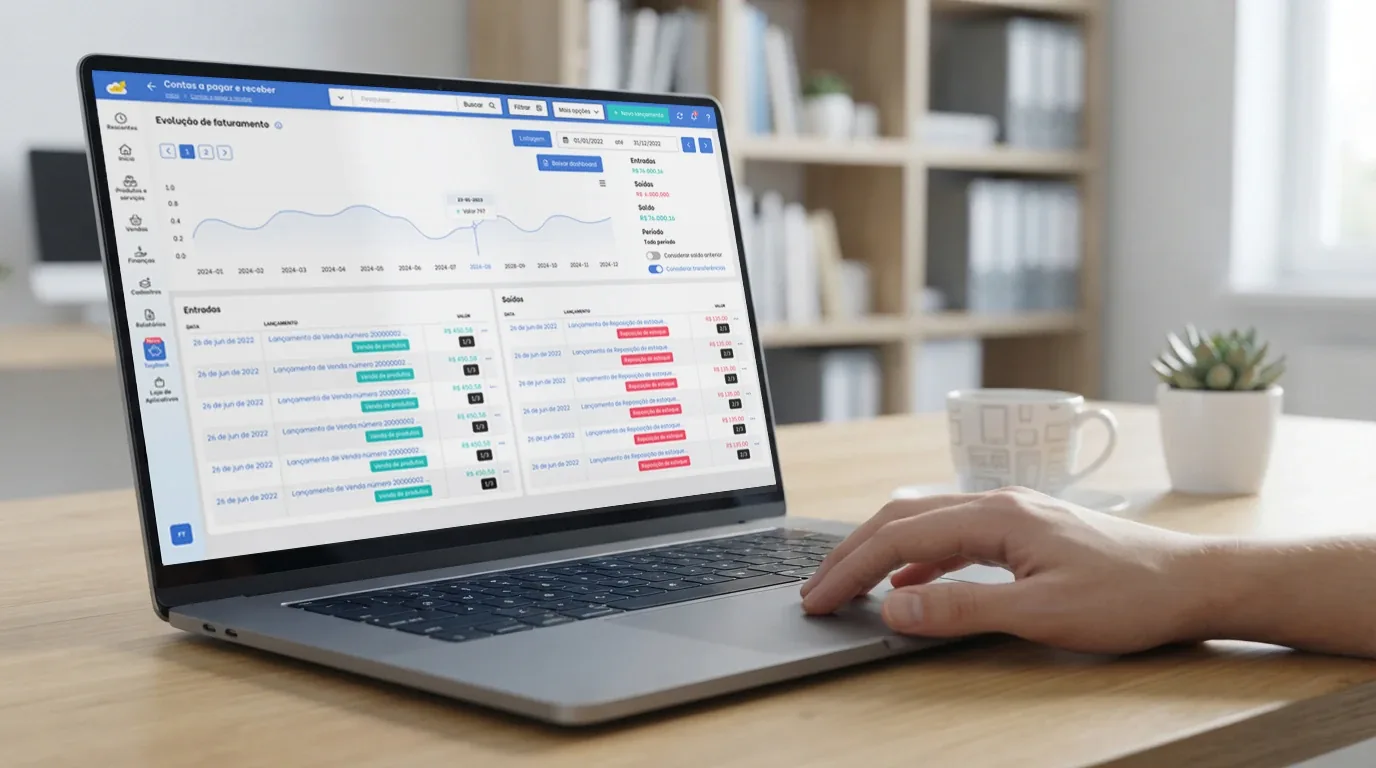
Covering functions like expense and revenue control, cash-flow forecasting, scheduling of accounts payable and receivable, issuing invoices and bank slips, and inventory control, financial-control software is easy and simple to use, fast, and intuitive.
In this software, information is more accurate and accessible, with greater precision and consistency; organizing expenses and other financial-control items becomes easier, and all of this enables better planning and a more efficient strategic analysis.
Viewing data and reports is also much better and easier to understand, even including demonstrative charts like the ones in the TagPlus system.
Controlling your business's finances means having awareness of its real financial situation. That is, knowing the best time to make investments or not. Don't put it off — start a rigorous, effective financial control right now to secure your business's success!
Ready to simplify this routine at your business?
Use TagPlus to put this into practice in your business, hassle-free.