
Business Management
Many business owners manage to keep their business running for years on end; others, on the other hand, don't make it past one year. There's also the group of entrepreneurs who never give up and keep constantly shifting focus, believing the reason behind their business's failure lies in the crisis, their products, or their customer focus.

Why don't so many businesses survive?
However, what many don't realize is that this is, most of the time, due to poor management at that business.
The business is usually opened without any kind of planning and kept running the same way, if not worse, which leads to its inevitable closure.
But how do you change this scenario? Is it possible?
Yes, changing this business's story lies in properly managing it.
How do you carry out this kind of management?
It sounds very complicated, but the answer is simple and clear: the business owner just needs to focus on business management.
For those new to the subject, or who can't quite grasp the idea, we'll explain it all below. By the end, a new entrepreneur will be born, ready to take better care of their business and thrive.
So don't miss this read!
Business Management
We can say that the term business management is tied to the strategic administration of companies. It refers to management techniques, evaluation, and the set of tools designed to help all kinds of businesses make high-level strategic decisions.
Business management can be seen as the set of choices, guidelines, and values laid out in pursuit of long-term development. Strategies that help anticipate problems that may arise along the way, also aiming to reduce the risk of failures.
Each business's strategy can be found in its objective and mission. Some focus on cost reduction, others on innovation, expansion, or even internationalization. Being strategic means preparing to face and overcome challenges, spotting threats and opportunities that don't yet exist.
Through these business-management values, the professional is able to act as an administrator, showing drive, proactiveness, the ability to develop a project or organize a team with mission, vision, and values, achieving all of it with scientific knowledge to reach the goal — in other words, having the competence to meet what's required.
On top of that, they gain organizational creativity, knowing how to use the resources available to them, from raw materials to labor, standing out through good use and satisfactory results at a low cost.

Advantages brought about by Business Management
Among other things, the benefits this brings to a business are:
- Customer focus;
- Leadership;
- People engagement;
- Process approach;
- Systemic approach to management;
- Continuous improvement;
- Factual approach to decision-making;
- Mutual benefit in the relationship with suppliers.
The importance of Business Management
As we saw before, many business owners fail by not putting business management into practice at their workplace.
A business's survival basically depends on its ability to create value for its stakeholders.
This way, the business needs, more than ever, to keep up with constant changes in its environment, identifying existing threats while still pursuing new growth opportunities.
The company, this way, maintains competitive advantages in the market niche it operates in — standing out among the many others that don't follow this process.

Technology and Business Management
We talk about business management through technology when we use strategic information to manage a system's data, helping guide the company's decision-making process.
These programs represent the natural evolution of management systems in the face of businesses' needs for the information they collect and process. Their purpose is to stay close to the competitive edge of countless businesses, and even redefine a company's guidelines to readjust it to current needs.
That is how the TagPlus system operates. It can be seen as strategic-management software that supports or reshapes the paths your business takes, through:
- competitiveness;
- cooperation; and
- a suitable organizational structure.
TagPlus, above all, aims to establish company-wide coordination to improve its position relative to general goals — achieving, for example, greater profit or lower costs.
TagPlus's Business Management Tools
Every tool available in the system aims to help the business owner reach their goals and handle their daily tasks; let's take a look:
Among other things, TagPlus offers:
- Customer registration and management;
- Product registration;
- Product charts and reports;
- Automatic supplier and product registration;
- Sales control;
- Creation of sales orders and service orders;
- Points of sale;
- Sales receipt printing;
- Purchasing management;
- Purchase orders;
- Cost-value calculation;
- NFC-e, NF-e, Fiscal Receipt, and NFS-e issuing;
- Automatic financial control;
- Bank slip issuing;
- Accounts payable and receivable control;
- Integrated online store.
TagPlus adds value to your business, no matter its size.
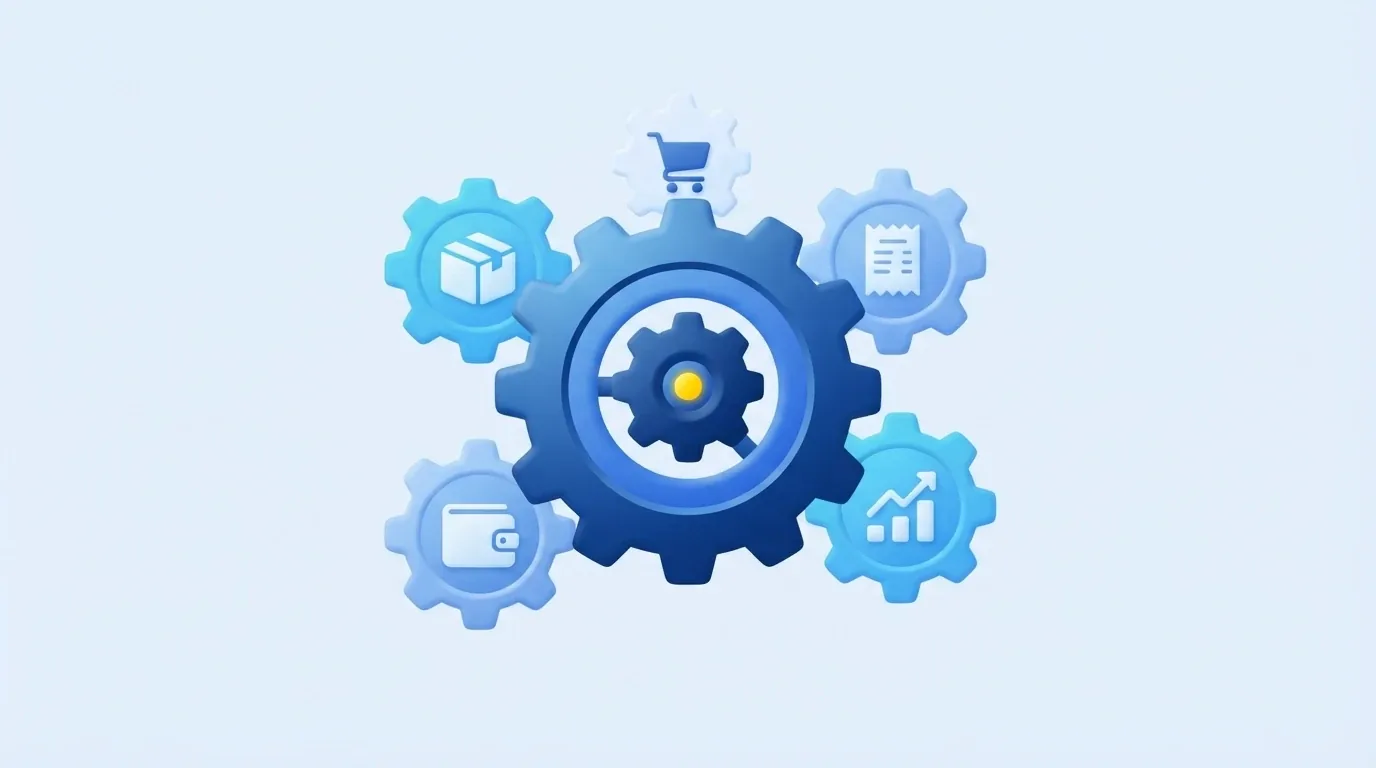
A business is like a big machine, with several gears operating at once. What TagPlus does is treat that machine as a whole, instead of looking at just one piece at a time.
By doing this, the system makes it possible to spot where the problems are and how to improve work processes.
Join the team of winning business owners who use the TagPlus system for their business management. Free up time to handle the other tasks your business needs.
See firsthand how management software transforms your business
To see the power of management software, you can try the TagPlus system for free, without even needing to provide your credit card!